
Career practice
A DevOps Portfolio Project You Can Explain: The Evidence Checklist
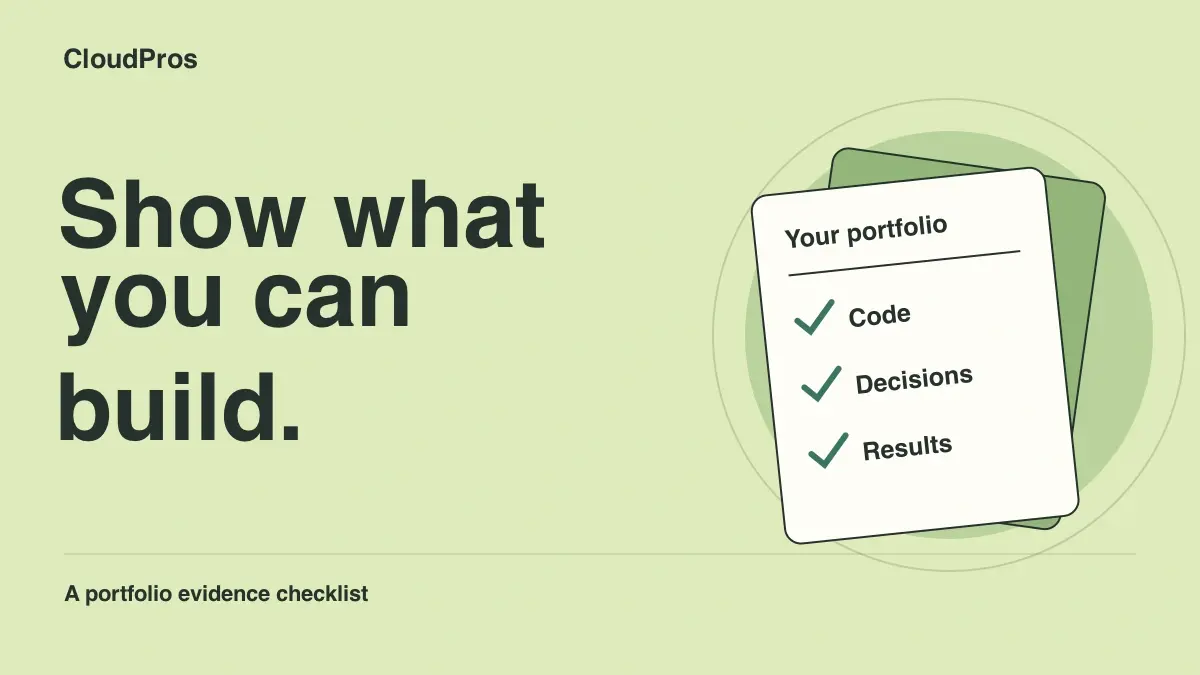
A useful DevOps portfolio shows how you think when a system changes or fails. One small application with a reproducible build, a clear deployment path, and a tested recovery procedure can tell a stronger story than a collection of copied architecture diagrams.
Use this checklist to organise a project you can share with employers and discuss in interviews.
Need a concrete brief first? Choose one of these DevOps projects for beginners. Use the checklist to review your finished work.
Start with a deliberately small application
Choose a service you can understand: a notes API, a static site with a health endpoint, or a small Python application. Write down what it does, who uses it, and what successful behaviour looks like. Keep the application simple enough that infrastructure and delivery decisions remain visible.
Your first deliverable is a README that lets another person run it locally. Include prerequisites, commands, expected output, and a way to stop and clean up the environment. If the instructions require an unexplained secret or a forgotten manual step, the project is not reproducible yet.
Show the path from a change to a release
Use Git to record meaningful changes. Add a test that fails when expected behaviour breaks. Your pipeline should run that test and build an identifiable artifact. Document which step publishes the artifact and which step releases it.
GitHub’s workflow documentation explains events, jobs, runners, and steps. Use those concepts to label your own pipeline diagram. A green screenshot is less informative than an explanation of what each check proves.
Capture evidence of a failure and recovery
In an isolated lab, introduce one reversible problem: an incorrect application port, a missing environment variable, or an image reference that does not exist. Before changing anything else, record the symptom and your hypothesis.
Keep a short investigation log:
- What did the user or health check observe?
- Which read-only command or signal did you inspect first?
- What evidence ruled out your initial guess?
- What did you change, and how did you verify recovery?
Remove credentials and personal data from screenshots and logs. The value lies in your reasoning, not in exposing a real account.
Document decisions, not just tool names
For each important choice, write the problem, the options you considered, and why you chose one. Explain why a local container is enough for one exercise, or why a cloud service is useful for another. Do not add Kubernetes purely to lengthen the tool list.
Create a small decision record with five fields: context, decision, alternatives, consequences, and what would make you revisit it. Include the cost and maintenance tradeoffs where they influenced your choice.
Review the project as a stranger would
Open the README in a fresh environment or ask a peer to follow it. Check that links, sample configuration, test commands, and cleanup instructions work. Confirm that your diagram matches the current repository.
Before sharing, you should be able to explain the request path, the release process, the failure you investigated, and the most important limitation. Include a short runbook so someone can see how you would operate the application after deployment.
A concise walkthrough can follow this order: what the application does, how a change reaches it, how you know it works, what you learned when it failed, and what you would improve next.
Continue building
Explore the CloudPros practical curriculum for connected Linux, pipeline, infrastructure, and operations challenges. If you need the vocabulary first, start with the DevOps glossary.
When the evidence is ready, use the DevOps CV and resume guide to describe it accurately.

CloudPros editorial team
Practical guides to DevOps, cloud engineering, and the work behind reliable software delivery.